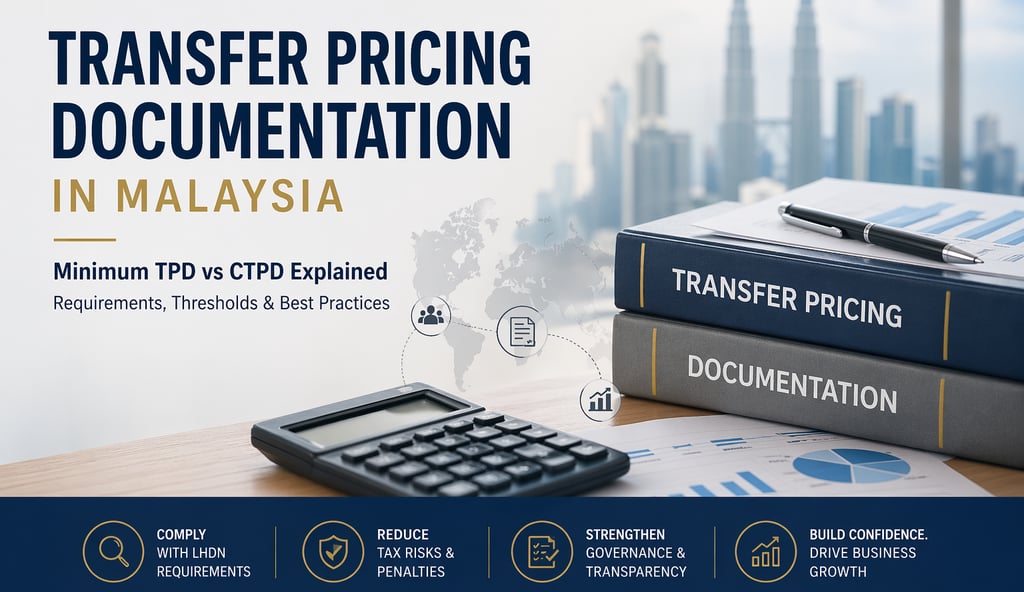
Transfer Pricing Documentation in Malaysia: Minimum TPD vs CTPD Explained
Understand transfer pricing documentation in Malaysia, including Minimum TPD and CTPD requirements, thresholds, and how to stay compliant with LHDN.
TECHNICAL UPDATES
4/23/20262 min read
As Malaysia’s tax landscape continues to evolve, transfer pricing (TP) documentation is becoming an opportunity—not just an obligation—for businesses to strengthen governance, improve transparency, and confidently manage tax risks.
With guidance and oversight from the Inland Revenue Board of Malaysia, companies today are encouraged to adopt a more structured and proactive approach to related party transactions.
Understanding Transfer Pricing: A Quick Refresher
Transfer pricing governs how businesses price transactions between related entities—whether for goods, services, financing, or intellectual property.
The guiding principle is simple:
Transactions should reflect what independent parties would agree under similar circumstances (the arm’s length principle).
When properly implemented, transfer pricing ensures fair profit allocation, reduces disputes, and enhances credibility with tax authorities.
Minimum TPD vs. CTPD: What’s Required?
Malaysia adopts a tiered approach to transfer pricing documentation under the Income Tax (Transfer Pricing) Rules 2012 and the Transfer Pricing Guidelines issued by LHDN.
1. Minimum Transfer Pricing Documentation (Minimum TPD)
Minimum TPD applies to taxpayers with lower-risk or smaller-scale related party transactions.
Typically, this includes:
Basic company and group information
Description of related party transactions
Simplified functional analysis
A reasonable explanation of pricing
The objective here is practicality—ensuring businesses maintain sufficient support without excessive compliance burden.
2. Full Contemporaneous Transfer Pricing Documentation (CTPD)
CTPD is required for taxpayers that meet certain thresholds, generally involving:
Annual gross income exceeding RM25 million, and
Related party transactions exceeding RM15 million, or
Specific categories such as financial assistance exceeding RM50 million
CTPD must be prepared contemporaneously—meaning:
It should be in place by the time the tax return is filed, not prepared after an audit begins.
A full CTPD includes:
Detailed industry and economic analysis
Comprehensive functional (FAR) analysis
Selection and justification of TP methods
Benchmarking studies using comparable data
Financial analysis supporting arm’s length pricing
Think of CTPD as a defence file—structured, robust, and ready to be submitted upon request.
Why This Matters: A Positive Perspective
Rather than viewing TP documentation as a compliance burden, leading businesses are using it to:
Strengthen internal pricing policies
Improve consistency across group entities
Enhance audit readiness
Reduce the risk of disputes and penalties
In fact, well-prepared documentation often leads to smoother tax audits and faster resolution.
Practical Advantages of Getting It Right
Businesses that invest in proper TP documentation can benefit from:
Greater certainty in tax positions
Reduced likelihood of transfer pricing adjustments
Lower exposure to penalties
Stronger corporate governance and transparency
How to Approach TP Documentation Effectively
A practical and sustainable approach includes:
Preparing documentation annually (not retrospectively)
Aligning TP policies with actual business conduct
Maintaining intercompany agreements and support
Using reliable benchmarking data
Reviewing thresholds regularly to determine Minimum TPD vs CTPD applicability
How We Support Your Journey
At Loi & Co, we believe transfer pricing is more than compliance—it’s about building confidence and clarity in your business structure.
We help clients:
Determine whether Minimum TPD or CTPD applies
Prepare audit-ready documentation
Navigate LHDN reviews with confidence
"Together We Grow, Together We Thrive"